Header image  
in County Mayo  


_______________________

_______________________

_______________________


County Mayo

One of the Irish favourite pub songs is called "The green and red of Mayo," and it provides great advertising for County Mayo all around the island. Its name "Mayo" (pronounce May O), comes from the Irish Maigh Eo and has nothing to do with the famous French product from Dijon. Mayo means "plain of the yews". As have most of the counties of the West of Ireland, Co. Mayo has remained "wild". Apart some little towns, such as Ballina, Castlebar and Westport, you will see only mountains (including Croagh Patrick!), rivers, lakes and sea cliffs. This means that there are lots of photo opportunities when visiting Mayo. In brief, County Mayo will offer you a choice of things to do and see.

Here are some examples in images and in text of what you can see and do in Mayo:

 
1. Visit the town of Ballina...
[FreeLike] If you go to Ballina, you will find it hard to believe that it really is the second main town of the county with only 10,500 inhabitants. Ballina is an ideal stopping place to visit the rest of County Mayo. From there, you will only have a few kilometres to go to have a seaweed bath in the Inniscrone area, in the neighbouring County Sligo.
2. Admire the countryside of County Mayo...
[FreeLikeLikeLike] County Mayo is essentially rural as mentioned previously. You will see more countryside than towns when you visit. On the right-hand side, you see a photo taken on the N17 leading to Sligo.
3. Pass by Achill Sound...
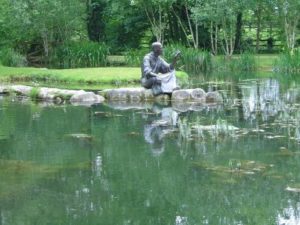
[FreeLikeLikeLike]
To access Achill Island, you will have to cross the Corraun Peninsula, before crossing a bridge linking the island to the mainland. On the right-hand side, you can see a photo taken in the area before reaching Achill Island
4. Observe fishermen on the beach of Keem...
[FreeLikeLikeLike]
The beaches and the water around Achill Island are of good quality. This is probably why you will see fishermen on this beach (Keem Bay, Achill Island). Note that the name "Achill" has nothing to do with the Greek mythology. In Irish, the name means "Eagle". Historically, the island sheltered various families of eagles, which have all disappeared today. The white-tailed sea eagle lived there until 1875, and golden eagles until 1915. The islanders regarded these birds of prey as dangerous pests and have probably contributed to their extinction.
5. Walk in the famine village of Achill Island...
[FreeLikeLikeLike]
Some also call it "the Ghost Village", but there’s nothing to worry about here! No chains or wicked spirits will disturb your visit as this is "a famine village". This was actually a village which was abandoned during the famine period. County Mayo indeed suffered from the highest emigration rate in Ireland during the 1840-1880 period. Figures show that its population dropped from 389,000 to less than 200,000 in 1901. Achill Island, located so far from everywhere, couldn't unfortunately counteract this trend, as shown by all those abandoned houses, whose only present inhabitants are plump sheep herds.
6. Visit a megalithic site at the bottom on Slieve More...
[FreeLikeLikeLike]
Just a few kilometres from the abandoned village of Achill, a small climb on Slieve More allows you to access a megalithic tomb site, from where you'll be able to admire a beautiful view on the cliffs of Achill and the villages of Keel and Dooagh. Enjoy!
7. Be photographed near the Keem Bay...
[FreeLikeLikeLike]
Achill offers a lot of scenery in front of which you can be photographed (see me, as an exampleSmiley, on the right-hand side). This part of the world is known for producing its own microclimate. During my first visit in 2003, the weather remained very hazy all weekend, while only a hundred kilometres from there, in Galway, the sun was shining.
8. Admire Croagh Patrick...
[FreeFreePArkingLikeLike] Croagh Patrick, which is also locally called "the Reek" is an important pilgrimage site in Ireland, and was of importance for worship before the arrival of Christianity. It is easy to imagine that pagans were fascinated by its unusual shape and its dominating location above Clew Bay. Nowadays, around 15,000 pilgrims climb Croagh Patrick on the last Sunday of July (also called Reek Sunday).
9. Climb Croagh Patrick and fight gravity!
[FreeFreePArkingLikeLike]
"I'm exhausted!", "Who had the idea to come here?" "Are we there yet?" you will rarely hear so many people complaining per square metre. Let's be fair... even if it's only 764 metres high, climbing Croagh Patrick is quite a challenge. Some fit people are able to climb the mountain running (I frankly would love to know how they manage it). Traditionally, pilgrims should make the climb, barefoot and at night, which somehow allows them not to be discouraged by the challenge. Personally, I decided to climb Croagh Patrick, wearing my trekking shoes and in daylight. As a rule of thumb, it takes about 1h45 to do the climb, which includes several breaks to re-hydrate yourself and take plenty of pictures! Overall, the climb is quite difficult because the ground is not only very rocky but also very unstable in parts of the mountain (sometimes you'll climb 50 cm and you'll go down 20cm).
10. Admire the view from Croagh Patrick...
[FreePArkingLikeLike]
Once you reach the summit, you'll be rewarded with a fantastic view over Clew Bay, which contains hundreds of islands, created during the last Ice Age. Contrary to what one may think, you won't be able to find panoramic restaurants or any pubs on the mountain: Croagh Patrick is primarily a pilgrimage site, so you'll find a chapel (open on Church holidays and during the summer time), a little cairn and Saint Patrick's bed.
11. Descend Croagh Patrick and fight gravity...
[FreePArkingLikeLike] So you were thinking you were safe and that you'll be able to scoff at the poor souls who still haven't reached the top of Croagh Patrick? From my experience, I don’t think so, going down Croagh Patrick is sometimes more dangerous than climbing it. The ground is very unstable and I think I fell on my behind at least 4 times Smiley. The best advice is to take it easy (Tog go bog é!) when you go down.
12. Let's pray in Ballintubber...
[FreePArkingLikeLike] If you were a good pilgrim, it used to be good practice to stop in Ballintubber Abbey, before taking the road to Croagh Patrick. The abbey was built by King Cathal of Connaught in 1216 and this is the only church founded by an Irish king still in use in the country. Note that the abbey is located at more than 30 kilometres from Croagh Patrick... Our Irish ancestors were very brave to do this "little walk" barefoot!
13. Have a drink in Westport...
[FreePArkingLikeLike] Westport is considered as one of the most dynamic towns in the West of Ireland. It is easy to understand why: first, Westport is well located just few kilometres from the coast and from Croagh Patrick, it is well served by a railway line, it hosts many festivals, the houses and shops are well maintained and its streets are very clean (the town has received many awards). Everything is made to enjoy a good quality of life in this part of the world. Pictured here is the Carrowbeg River, which flows through Westport.
14. Cycle on Newport-Mulranny Greenway...
[FreePArkingLikeLike] Co. Mayo launched an excellent project in 2010: the redesign of the former Newport / Mulranny Railway (which closed in 1937) into cycling track. This project will be a great promotion for this beautiful part of Ireland, which is usually quickly passed through but rarely explored.
 
              RSS
 
County Mayo in pictures
Welcome to County Mayo
 
Mayo
Photo 2. View on County Mayo.
Achill Sound
Photo 3. Achill Sound.
Keem
Photo 4. Fishermen on Keem Beach.
Famine village of Achill
Photo 5. Famine village of Achill at the bottom of Slieve More.
Keem
Photo 6. Megalithic Tomb.
  Keem
Photo 7. I near Keem Bay.
 
  Croagh Patrick
Photo 8. The majestic Croagh Patrick.
 
  Croagh Patrick
Photo 9. Climbing Croagh Patrick.
 
  Croagh Patrick
Photo 10. On top of Croagh Patrick - view on Clew Bay.
 
  Croagh Patrick
Photo 11. Going down Croagh Patrick...
 
  Ballintubber
Photo 12. Ballintubber Abbey.
 
  Westport
Photo 13. Carrowbeg River goes through Westport.
 
  Newport
Photo 14. A bridge in Newport


Would you like to visit another Irish County? Then, please click on one of the following links: Antrim (Belfast; County); Armagh; Carlow; Cavan; Clare; Cork (City; County; Islands); Derry; Donegal; Down; Dublin (City; County); Fermanagh; Galway (City; County; Aran Islands); Kerry; Kildare; Kilkenny; Laois; Leitrim; Limerick; Longford; Louth; Mayo; Meath; Monaghan; Offaly; Roscommon; Sligo; Tipperary; Tyrone; Waterford; Westmeath; Wexford; Wicklow.  

Legend:
Like
Nice; LikeLike Worth a visit; LikeLikeLike Well worth visiting
Please note that this grading system is only based on my interests and personal experience as a French expat in Ireland. Feel free to visit the same locations and share your experience Smiley.
Free Free or Not Applicable Euro Entrance fee ≤€5 ; EuroEuro €5<Entrance fee≤€10 ; EuroEuroEuro €10<Entrance fee≤€15 and so on...
These price ranges are indicative only to help you plan your holiday budget and are subject to change. Discounts generally apply for families, groups, children, students and seniors citizens.
Parking While the admission to this site is free, a parking fee may apply.
OPW Heritage Site managed by the Office of Public Works. Most OPW sites are free of charge on the first Wednesday of every month during 2011. A Good tip: the Heritage Card entitles you unlimited admission for one year to all OPW sites (around €21).

 
This page's keywords: Ireland, Mayo, Castlebar, Westport, River Moy, Ballina, County Mayo, Achill Sound, Fishermen, Keem, Achill Island, Keem, Slieve More, Croagh Patrick, Newport, Carrowbeg, Ballintubber, Clew Bay, Reek.  
Photos&Copyrights | Site Map | Home | Affiliation | CV | Contact


Sébastien Rolland - French expat in Ireland since 2002.


Freisk! is an Irish sole trading business. CRO: 421733 - VAT: IE 4395558V


© 2003- (www.freisk.com). All rights reserved.