| County Roscommon |
After tidying my photos related to Co. Roscommon, I have to acknowledge that, despite what one may think at first, there is plenty to see and do in County Roscommon. Coal Mines, great walks, historical sites and beautifully managed gardens will make a lot of amateur photographers happy.
If you plan to go through this county, here's some examples of what you could see, do or visit. |
| |
1. Enjoy Arigna Mine experience...
[    ] In my opinion, Arigna symbolises a clever way to recycle a former industrial site. The Centre provides visitors a unique insight into what coal mining life was like in the Arigna Valley, from its opening in the 1700's until its closure in 1990. Note that the guided tour is carried out by former miners who worked at the mine, which allows you to ask them anything about their difficult working conditions. |
2. Admire small waterfalls in the Arigna Valley...
[   ] Soon after leaving the mines, it is possible to admire the views of Lough Allen, or of the numerous small waterfalls on the hills around Arigna (see photo on the right hand side). |
3. Drive on National Road N4...
[   ] This is a photo of the landscape taken while travelling along the N4 route, leading to Boyle. Yes, the chosen angle can leave you feeling a bit dizzy... |

Photo 3. Horse on the N4. |
4. Admire the River Boyle...
[   ] On the right-hand side, you see a photo a "little corner of nature", taken near the small town of Boyle (around 2500 inhabitants). |
5. Visit Boyle Abbey...
[   ] If you visit the town of Boyle, don't pass up the opportunity to visit its abbey. Boyle abbey is an impressive and well-preserved Cistercian Monastery, which was founded in the 12th century under the patronage of the local ruling family, the MacDermotts. It was used to accommodate a military garrison during the 17th and 18th centuries. |
6. Visit the Roscommon Castle and the town of Roscommon...
[ ]
Roscommon Castle itself was initially built by the Normans in 1269 but like many Castles in Ireland, it didn't have a lucky history. Four years later, in 1273, it was captured by the Irish and raised to the ground. It was then rebuilt in 1280 and remained in Irish hands until 1652 when it was partially blown up by Cromwellian troopers. It was finally burned down in 1690. Today, the ruins of Roscommon Castle (considered a National Monument) are located to the north of the town. There’s no charge to visit the Castle and enjoy the park surrounding the castle. Apart from the castle, Roscommon town shelters the County Museum and Tourism Centre, which now contains many interesting exhibits and artifacts illustrating the history of Roscommon. Plenty of others attractions could be visited (Roscommon Abbey, dating back to the 1200s, Harrison Hall, built in the 1700s, Roscommon County library, built in 1783 initially as an infirmary, the Old Gaol, today re-conditioned with shops and a restaurant, etc.). Feel free to contact the Museum and the Tourism centre to get full details on what could be seen and done.
|
7. Observe Elphin Windmill...
[   ] This is a nice detached circular-plan three-stage windmill, built c. 1730, and very well restored in 1996. It can now be visited, however there is an entrance fee (6€ in 2008). Where buildings are privately owned or have been restored using private monies or collections in Ireland, there is always an entrance fee. |
8. Walk in Strokestown Park House...
[    ] Strokestown Park House is composed of an 18th century mansion and of a 2 hectare walled garden (see photo), which have been fully restored to their original splendour. Access to the garden is worth a tour but it remains a little expensive (9€ in 2008). This pricing applies whatever the season and to get the maximum effect from the gardens I’d suggest visiting anytime between the end of May and the end of August. |
9. Observe Knockanyconor Megalithic Structure...
[  ] The site is also called "The Stones" and is located in the small village of Lecarrow. You can find there the remains of a passage tomb, a portal tomb and concentric stone circles... |

Photo 9. Site of Knockanyconor. |
10. Pass by Athleague...
[   ] The village of Athleague is not well known. If you enjoy rambling, this is the ideal starting or finishing point of the "River Suck Way". There, you will also find geese like in the South West of France and even a charming old mill (see photo below). |

Photo 10. The village of Athleague. |
| |
11. Walk between Athleague and Castlestrange...
[   ]"The River Suck way" is one the Irish walk by the River Suck between Athleague and Castlestrange. In summer, the path is invaded by wild flowers (see photo). The walking track is pretty well defined and suitable for most pedestrians, but note that the path is not accessible most of the year because the local river can burst its banks (see photo #14). |
12. Study the Castlestrange Stone...
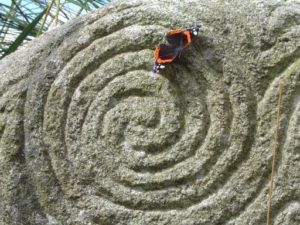
[  ] The Castlestrange Stone is a protected National Monument and is located in Castlestrange. It is a granite boulder decorated with flowing spirals in the La Tène style, dating from the Iron Age period between 500 BC and 100 AD. The use of the stone is not known but it is assumed they probably served some religious or ritual purposes. |
13. Visit Donamon Castle...
[  ] Donamon Castle is one of the oldest inhabited buildings in Ireland. Originally, there was a fort here from early times. The first recorded reference of the Castle is in the Annals of the Four Masters in 1154. The Castle was destroyed several times and inhabited by different families: the O'Finnaghys, the de Staunton, the de Birminghams and the McDavid Burkes. |
14. Walk in the Woods of Donamon Castle...
[  ] It is possible to walk in the woods and bogs beside Donamon Castle. However, you will need to choose your time wisely and go there preferably during the summer time. On the right-hand side, you can see a photo of a wooden bridge, which became isolated, because of the floods of the River Suck. |